Sashiko - Hana-Fukin Sampler
I picked up this Olympus Hana-Fukin Sampler in Kyoto during an October craft tour led by the amazing Kazue of Sashiko Lab. Kazue took me and another textile aficionado to many shops that cater to Sashiko, embroidery, natural dyeing, knitting, paper making, and fabric. I left with a bag filled with supplies to experiment went, along with a few premade kits.
This kit provided a base textile with stitching marks to follow. I started working on this while we had a break during holiday meal preparation, and furthered it on car rides and quiet mornings at home.
The instructions were all in Japanese, which was fine thanks to the help of google translate. I also have been working with several books that I brought back from Japan, and have found that the text itself is secondary to the diagrams- especially when you already have an understanding of techniques.
Hana Fukin translates to ‘Flower Cloth’, or ‘Kitchen Cloth’. These stitched cloths area small treasures, used in daily applications and also considered family heirlooms and wedding dowries. They can be used as decorative items, placemats, food coverings, gift wrapping, table runners, decorative pillows, etc. The stitches and thread reinforce the fabric, making them beautiful and also durable for use. The creation of the Hana Fukin itself is an example of patience and quiet meditation. They take time and planning to create.
This Hana-Fukin incorporated 2 patterns; ‘Kuguri Sashi’ and ‘Asanoha To Zenisashi’.
Kuguri in Japanese means to go under something, passing through, or weaving through. Sashi is a term for a stitch.
Asanoha breaks down to ‘Asa’ meaning hemp and ‘ha’ meaning leaf. This geometric pattern of entwined hexagons is symbolic of strength, good health, long life. Because the hemp plant grows quickly (four meters in four months), and is strong and sturdy, Asanhoa is a kisshōmonyō pattern, a lucky omen pattern offering protection from evil spirits or harm. Hemp is also important for Shinto rituals. When visiting shrines, the rope used to ring the bell that you ring is made of hemp. This pattern has a deep history in Japan’s textiles since the Heian period (794-1185) with a surge of popularity during the Edo period (1603-1868), and once you are familiar with it you see it everywhere.
Zenisashi breaks down to ‘Zeni’ meaning money or coins, and ‘sashi’ meaning to string. This refers to the tradition of stringing coins together. Zeni is a round coin with a hole in the center.
For the stitching, I used 4 different color threads; a white thread for the circle pattern, a blue thread for the horizontal and vertical stitches, and for the woven aspects I used a golden thread and a bright green thread.
Although the pattern was printed onto the textile as a guide, this piece took quite some time to accomplish. The pattern guide did allow me to settle into a quiet rhythm of work immediately, and to start quickly without laying the pattern out myself for a change. It gives you a larger appreciation of complex Sashiko pieces that had to have the pattern determined and drawn by hand ahead of sewing- which I actually enjoy doing as well.
I am very pleased with the end result, and have been displaying it over my record player as a dust cover in a prominent area of my living space.
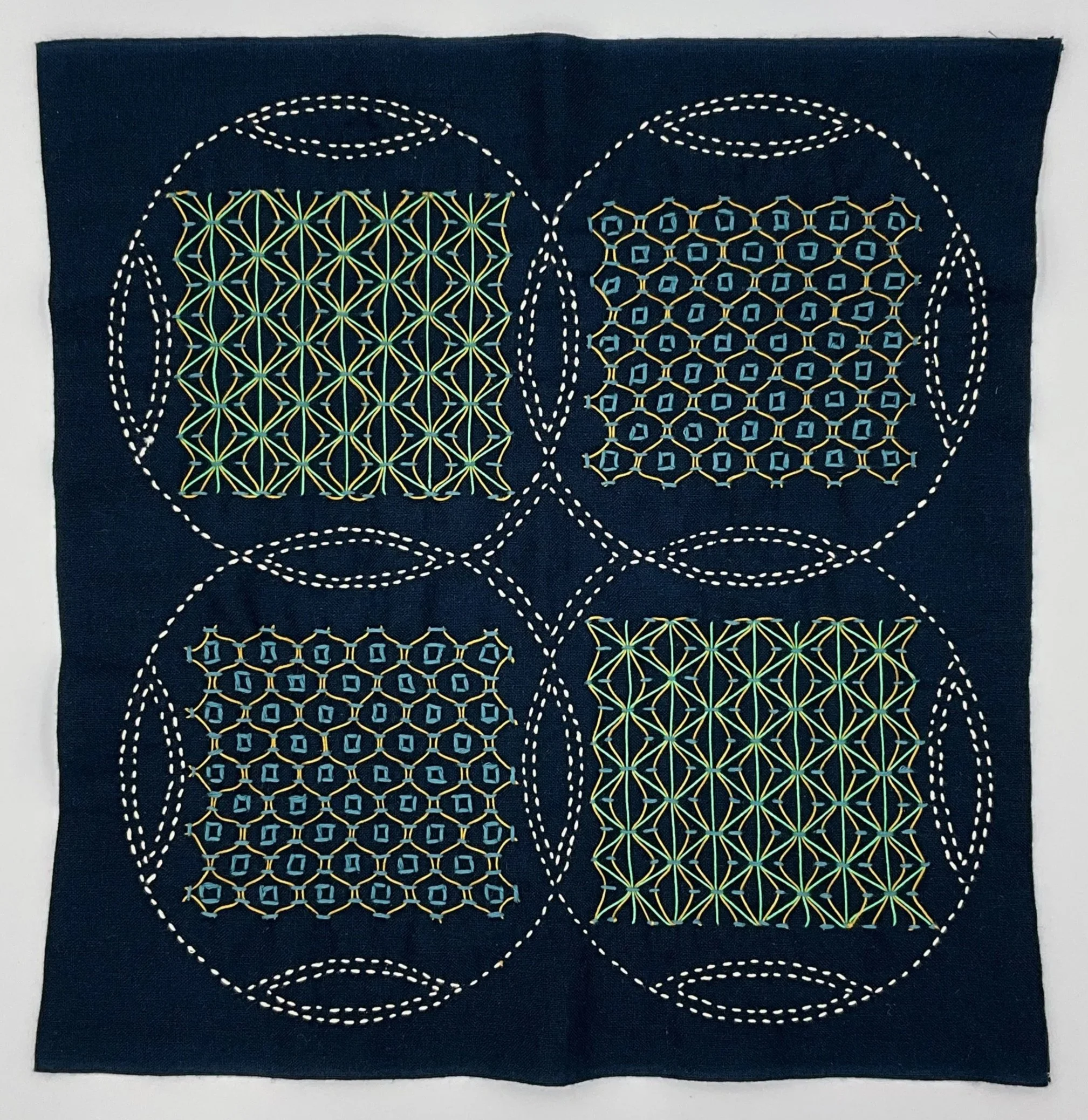
Front side of hana-fukin sampler kuguri sashi and asanoha to zenisashi
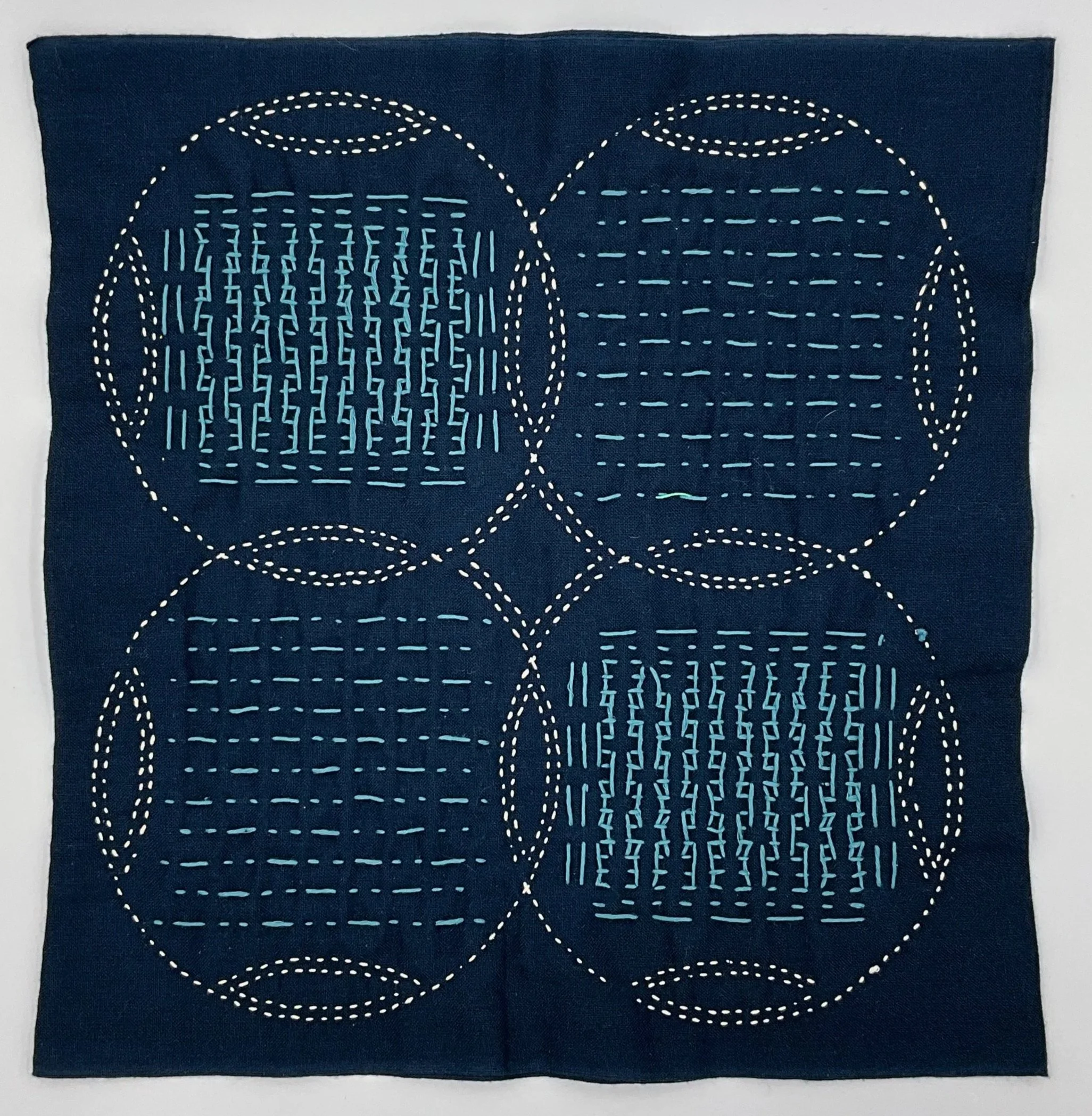
Back side of hana-fukin sampler kuguri sashi and asanoha to zenisashi